
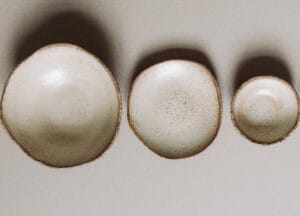


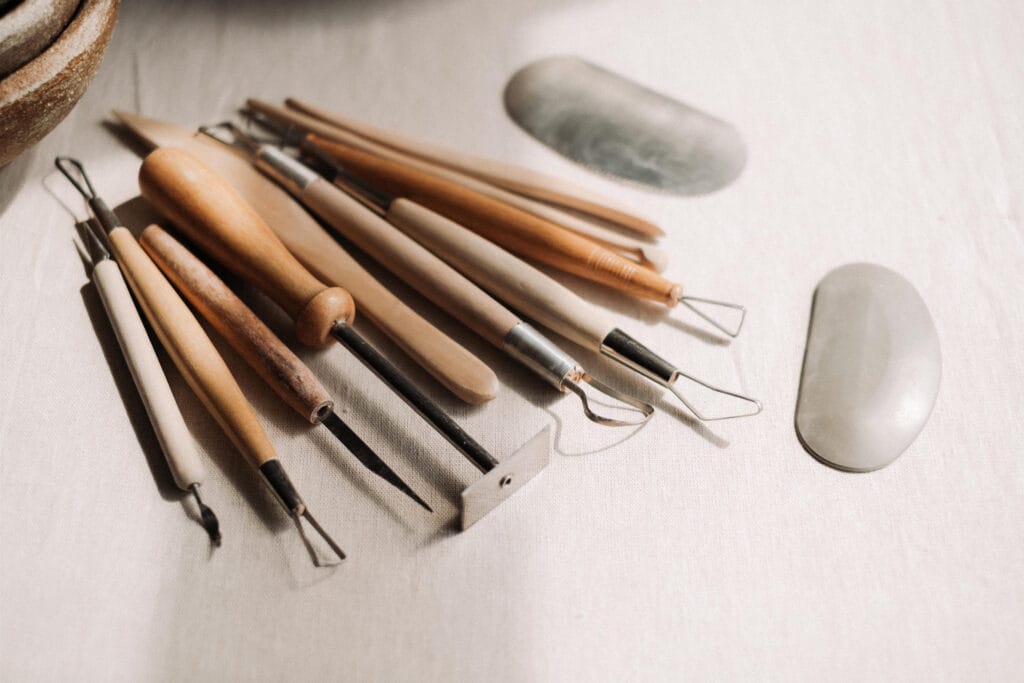
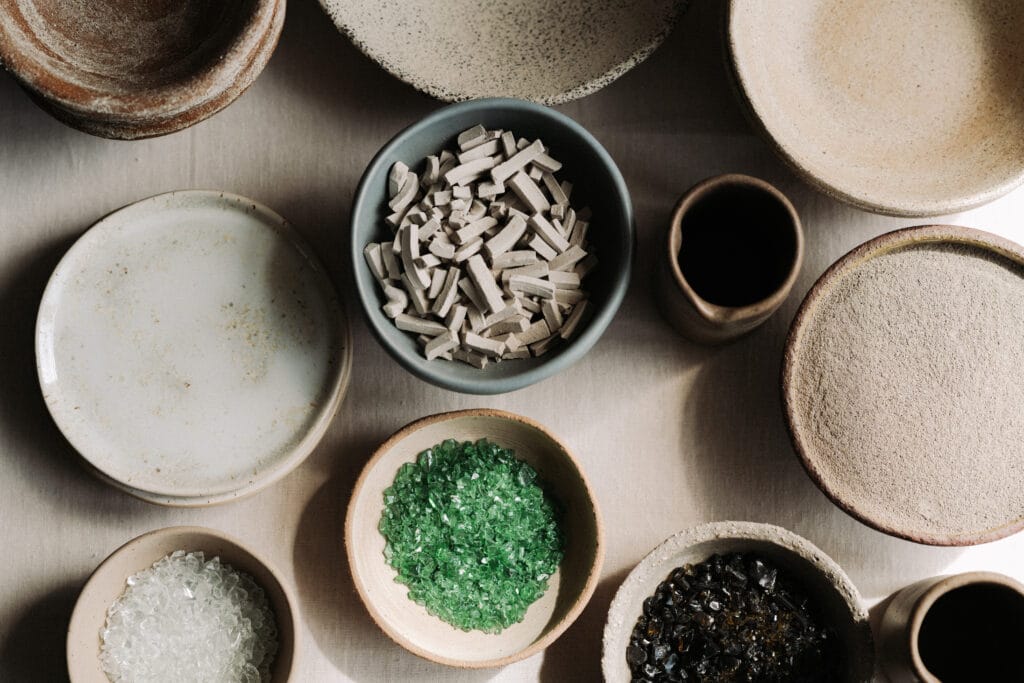
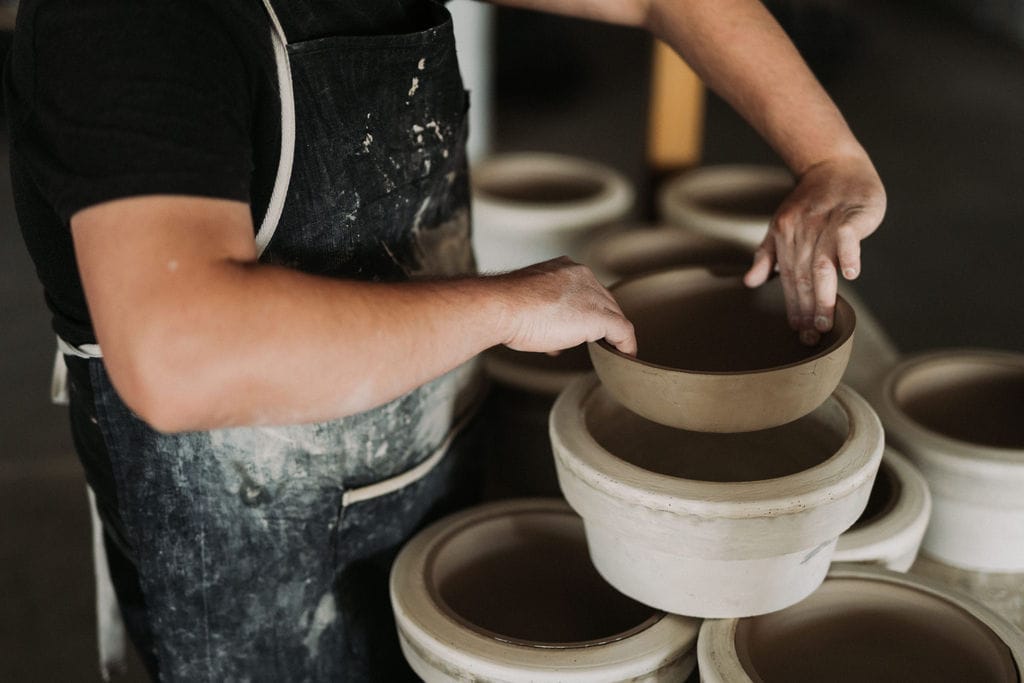
Every POEMI piece goes through a process that takes at least 4 weeks, from the lump of raw clay to the finished object that ends up on your table. It’s not a process we can rush: ceramics need time at every stage, from shaping to the two firings in the kiln.
In our workshop in Sibiu, we use several modeling techniques, chosen according to the shape and character of each piece: jiggering, trimming, manual modeling and slab building. Some objects go through a single technique, others combine several of them.
We are showing you, step by step, what happens in our workshop in Sibiu before a mug or a plate reaches your home.
Modeling
Everything begins with the clay. Depending on the shape we want to obtain, we use different modeling techniques:
Jiggering
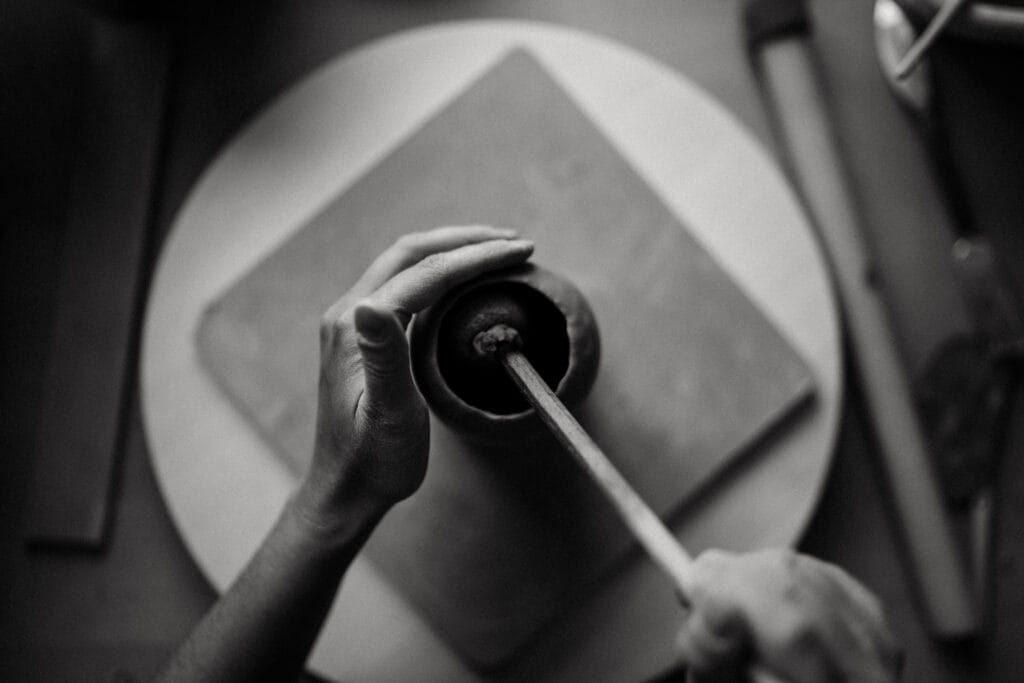
For certain forms, we use jiggering, a traditional technique in which clay is shaped on the wheel using a template form. The template presses against the moving clay on the wheel and gives it the desired contour, while the craftsman's hands adjust the thickness and symmetry of the walls.
It is a technique that offers very good control over the shape and allows for the production of consistent parts, while maintaining the craftsman's manual intervention.
Manual modeling
Some of the POEMI forms are created manually, without the help of a template form. The clay is shaped directly by the craftsman's hands, through pressing, stretching, and forming, until it takes on the desired shape.
This technique leaves more room for the human gesture and the small differences that make each piece slightly different from the next.
Slab building
For the shapes that cannot be obtained on the wheel, we use the technique slab building. The clay is rolled into sheets of controlled thickness, then cut and shaped to obtain the form of the object.
This is a suitable technique for certain types of plates with organic rims and platters of various shapes.
Trimming
After modeling comes the trimming. The piece, still damp enough to be worked, is fixed to the wheel, and the excess clay is removed from the edges and the base, where the foot of the object is formed.
This stage finalizes the proportions, defines the lines of the object, and gives it the right weight in the hand. It is also one of the moments where the craftsman's intervention is felt the most: each piece is individually adjusted, which explains the small natural variations between two objects that have the same shape.
Drying
After modeling and finishing, the pieces are left to dry slowly and in a controlled manner. It is one of the stages that requires the most time and patience.
Clay gradually loses water, and the piece shrinks. If the drying is too rapid or uneven, deformations or cracks may appear. That is why we do not rush this process. Ceramics have their own rhythm. The larger or thicker the piece, the longer the drying time.
First firing: bisque firing (950-1000°C)
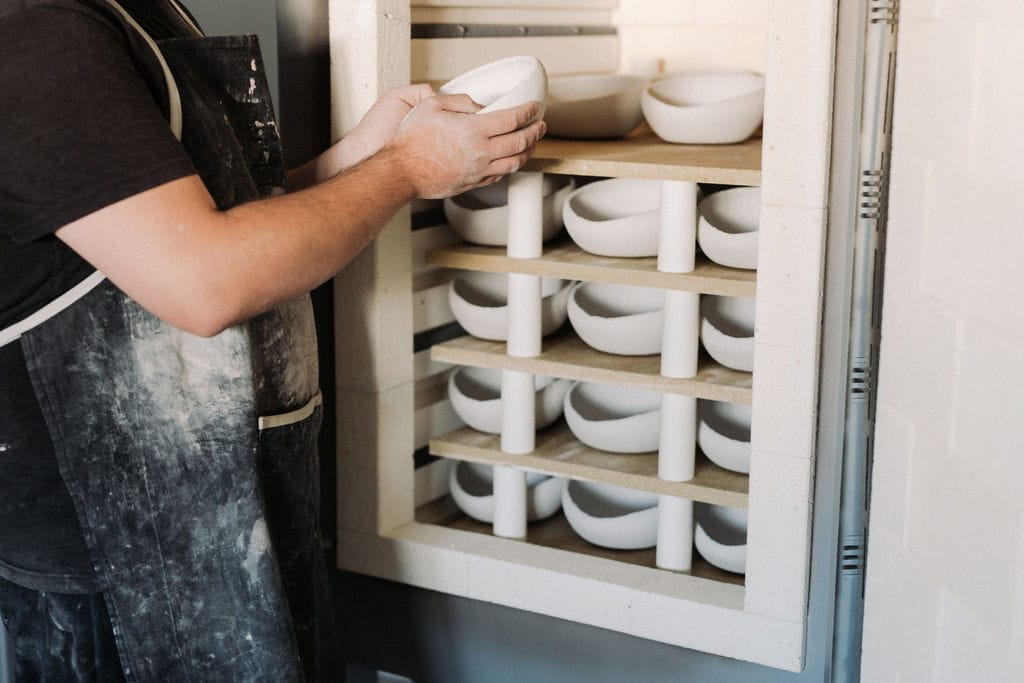
After the modeled clay has dried completely in the air, the pieces go into the kiln for the first firing, called bisque firing, at a temperature between 950-1000°C. This firing transforms the raw and fragile clay into a porous yet resistant material, called bisque, which can be handled and glazed without the risk of shattering.
Why is this intermediate stage necessary and why not move directly to glazing? Because air-dry clay remains too fragile to be submerged in liquid glaze or handled further. Bisquefiring fixes the shape permanently before the piece receives the glaze layer.
Glazing
The biscuit-fired pieces are then manually glazed by dipping, spraying, or brush application, depending on the glaze and the shape. The glaze is a mixture of minerals that, upon firing, melts and forms that glassy, smooth-to-the-touch layer that makes the ceramics safe for food contact and easy to maintain.
The consistency of the glaze, the thickness of the layer, and the positioning of the piece in the kiln directly influence the final appearance. That is why two mugs from the same series can have slightly different shades: it is the sign that each piece was individually crafted and glazed, not industrially mass-produced.
Final firing (1200-1250°C)
After glazing, the pieces go back into the kiln for the final firing, this time at temperatures between 1200-1250°C. At this temperature, the glaze melts completely and bonds with the ceramic body, and the material becomes dense and vitrified, meaning it significantly reduces its porosity.
It is this second firing that gives POEMI ceramics their durability for everyday use: they are dishwasher-safe, microwave-safe, and can withstand normal temperature fluctuations in the kitchen. The difference between a high-quality ceramic piece and a fragile one is actually determined right here, in the kiln.
We are often asked why we work with ceramic rather than porcelain. Porcelain is fired at even higher temperatures—typically between 1200 and 1400°C—uses pure kaolin, and has a fine, white, slightly translucent appearance. The ceramic stoneware we use at POEMI, on the other hand, retains the warm, natural character of clay, with excellent density and mechanical strength, making it suitable for everyday use. This choice is no accident: we seek objects that look and feel authentic, not perfectly industrial.
Quality control and the imperfections that give character
After the second firing, each piece is checked manually: shape, weight, glaze thickness, and any defects that could affect functionality or safety in use. The pieces that do not pass this inspection do not make it to the store.
At the same time, small variations—a slightly different shade of glaze, a subtle mark left by the hand that shaped the piece—are not considered defects, but rather proof that the object in front of you was handmade, not mass-produced. These are the marks of a process that takes at least four weeks and through which every POEMI object passes—from a lump of clay to the finished piece, ready to become part of your everyday table.
Why does the entire process take a minimum of 4 weeks? Because each stage needs its own time and cannot be rushed: the clay must dry completely before the first firing, the kiln heats up gradually to 950-1000°C and then cools safely, the hand-applied glaze must dry before the second firing at 1200-1250°C, and the kiln cools down again, slowly, at its own pace, before it can be opened. Patience is as much a part of the process as the clay and fire, and rushing would mean weaker pieces, with a higher risk of cracking or uneven glaze.
If you want to learn more about the people behind this process, you can read our story on the about us page. And if you are curious what the final result of these 4 weeks of work looks like, you can discover it POEMI products In the store.
 Romanian
  English